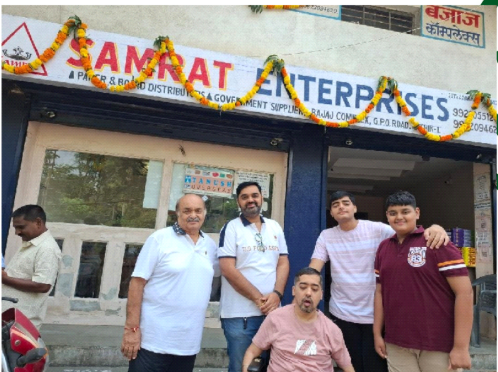
Our family business dates back to 1970, and I am the third generation involved in government auctions and supply. As a 10-12-year-old, I would accompany my father to government offices, collecting scrap with hamals and selling it to paper mills, rolling mills, and large scrap dealers. That early exposure sparked my lifelong connection with scrap.
In 1998, I started helping my father in the business. He would send me to scrap dealers to sell scrap generated from our printing press. I would sit in the delivery vehicle, go to the dealer, carefully watch the weighing because sometimes there were issues with the scale, collect the payment, and return home to hand the money to my father. Those small experiences taught me responsibility, trust, and the real ground reality of the scrap trade.
In 2007, I started my own work by participating in government scrap auctions and supplying scrap materials. Every month we would sell scrap, but the system was very traditional. Many unorganized buyers would come, bargaining was intense, and weighing issues were common.
The real turning point came in 2021 during the COVID period. We had won a government auction where nearly 25–28 truckloads of scrap were lying, including a lot of e-waste. Surprisingly, no one was ready to take the e-waste. One scrap dealer came to buy aluminum cables. When I asked him what he would do with them, he casually said he would take them outside the city, put them on rubber tyres, pour kerosene, burn everything overnight, and collect the metal in the morning.
That moment stayed with me. I felt uncomfortable and disturbed thinking about the environmental damage this would cause. When I told him this was wrong, his response was simple — "Mujhe farq nahi padta." That sentence made me realize how big the problem was.
At that moment I felt there had to be a better way. I saw a clear gap in the market — no organized system for responsible scrap and e-waste collection. That thought slowly turned into a mission: to build a technology-driven, transparent platform that collects scrap and e-waste responsibly, protects the environment, and brings structure to an otherwise unorganized industry.